

In the software development lifecycle, Low-Level Design (LLD) plays a vital role in bridging the gap between system-level thinking and actual implementation. Whether you're preparing for interviews, designing scalable systems, or collaborating in a tech team — understanding LLD is non-negotiable.
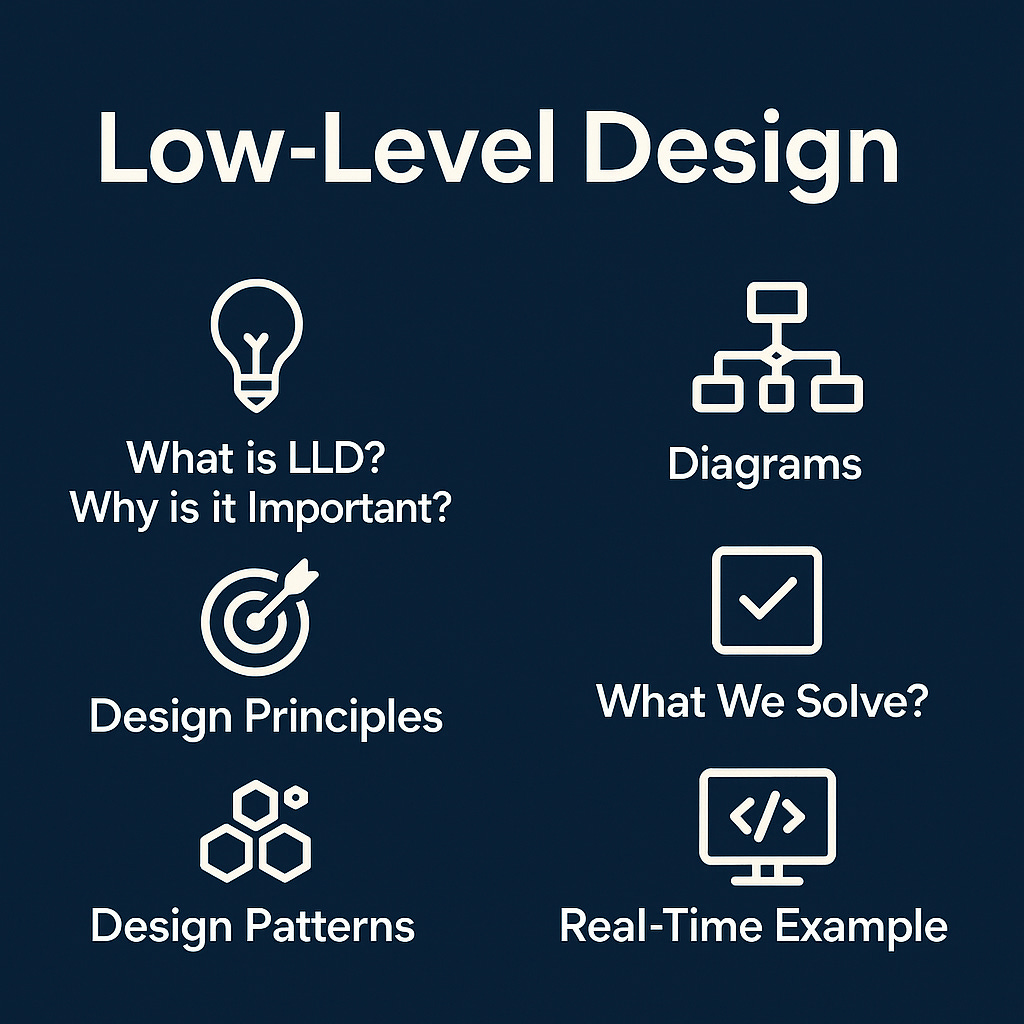
1. What is LLD and Why is it so important?
Low-Level Design (LLD) is the detailed design phase where you define how the individual pieces of a system will be built and interact. Unlike High-Level Design (HLD), which focuses on components and architecture, LLD zooms into class diagrams, methods, logic, and interactions.
Why it’s important:
Ensures clarity and consistency before coding begins
Catches edge cases and flaws early
Makes the code maintainable and extensible
Enables team collaboration with shared understanding
Helps in code reviews, testing, and debugging.
2. 🧩 Design Principles
Solid LLD is built on sound design principles. Here are some of the most important:
SOLID Principles:
Single Responsibility Principle
Open/Closed Principle
Liskov Substitution Principle
Interface Segregation Principle
Dependency Inversion Principle
DRY (Don't Repeat Yourself)
KISS (Keep It Simple, Stupid)
YAGNI (You Aren’t Gonna Need It)
Separation of Concerns
High Cohesion, Low Coupling
Following these ensures that your code is clean, modular, and testable.
3. 🏗️ Design Patterns
Design patterns are tried-and-tested solutions to common software design problems.
Creational Patterns (object creation):
Singleton, Factory, Abstract Factory, Builder, Prototype
Structural Patterns (class and object composition):
Adapter, Bridge, Composite, Decorator, Proxy
Behavioral Patterns (communication and interaction):
Strategy, Observer, Command, State, Chain of Responsibility
Using the right pattern improves readability, scalability, and maintainability.
4. 📊 Diagrams in LLD
Visuals play a huge role in making LLD effective. Key diagram types include:
Class Diagrams — Shows classes, methods, attributes, and relationships
Sequence Diagrams — Describes how objects interact over time
Component Diagrams — High-level modules and their relationships
ER Diagrams — For database schema and entity relations
These diagrams help developers and reviewers quickly understand structure and flow.
5. 🛠️ What Does LLD Help Solve?
Breaks down complex requirements into manageable modules
Defines clear contracts (APIs) between classes/services
Supports parallel development among team members
Prepares groundwork for testing and CI/CD pipelines
Documents the internal logic of the system for future reference
LLD is like creating a blueprint before constructing a building.
6. 📦 Real-World Example — URL Shortener
Let’s take a simplified example: designing a TinyURL clone
Classes: URLShortenerService, URLRepository, CacheManager
Methods: generateShortUrl(), getOriginalUrl(), deleteShortUrl()
DB Schema: Table with
short_code,original_url,created_at,expiryPatterns Used: Singleton (for service), Repository (for DB access)
Diagram: Class diagram showing interactions between components
This LLD helps developers implement features in isolation, test individual parts, and scale easily.